
The Weight We Carry
Parashat Va’etchanan

Shabbat Friendly Print Link
Flying Encumbered
Recently, on a flight, my husband and I sat next to a lovely man. He struck up a conversation with my husband, who, ever the friendly extrovert, was happy to make a new friend.
The man works in wealth management with athletes, has tattoos running down his left arm, believes in the power of positivity, and avoids social media for his mental health.
Toward the end of the flight, he asked what I do. I described my work in the Jewish community and mentioned an upcoming lecture I was scheduled to give on antisemitism.

His demeanor immediately shifted. “Yeah… the news is really bad.”
He looked at me in a way I can only describe as pitying. He told me that, as a white man with no other ethnicity, he couldn’t really understand what we’re going through.
Then he asked, with deep sincerity: “Have you given up on America?”
I found the exchange fascinating, not because of what he said, but because of how visibly uncomfortable he became. He seemed kind and curious. Without saying a word about his politics, he clearly wanted us to feel supported.
But afterward, I told my husband that I felt a difference between us.
This man is walking through the world with all the complexity of what it means to be human.
We are too, but with the added weight of what it means to be a Jew in history.
Is that what he was sensing? That it’s heavy sometimes?
If so, he’s right.
The Beauty—and Weight—of Being Jewish
To be a Jew is extraordinary—it means connecting to eternity. It means standing on the shoulders of giants. It means tasting messianic promise and exile and return and longing in every generation.
But it is not easy.
And that’s exactly what Moses tried to teach us in this week’s parasha.
We are now in the second portion of the book of Devarim (Deuteronomy). Moses, in the final year of his life, delivers a series of farewell speeches to the people of Israel. This week’s speech begins with something incredibly personal and raw: Moses recounts how, after being told by God that he would not enter the Promised Land, he begged for the decree to be overturned.
The Hebrew is intense—va’etchanan—he pleaded, beseeched, implored.
The rabbis note that the gematria (numerical value) of this word is 515—the number of times Moses prayed until God told him to stop.
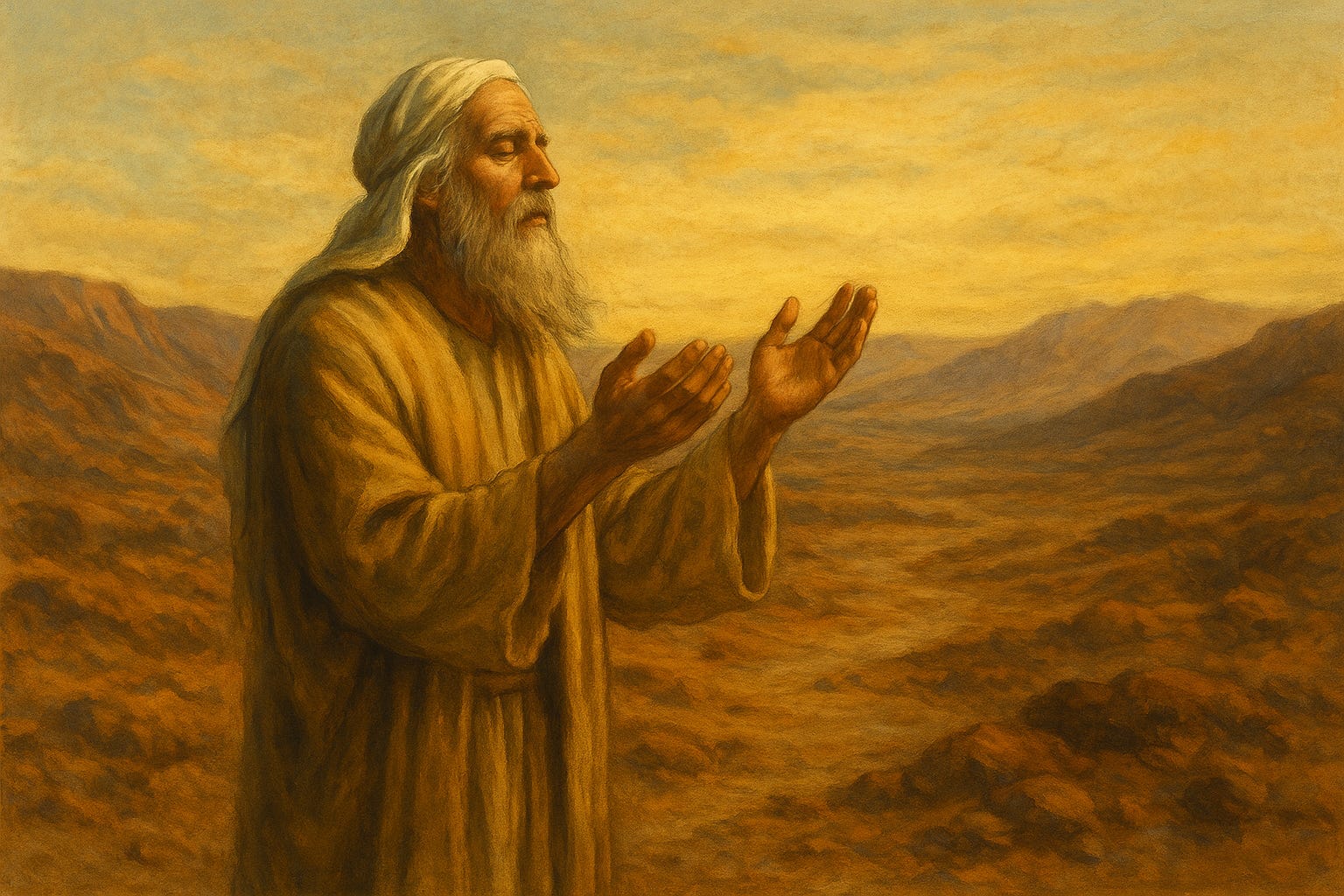
As a kid, this broke my heart. How could someone who gave his life to leading the Jewish people not be allowed to enter the land? I remember thinking how lucky I was—I could just jump on a plane to Israel.
But this year, I’m wondering:
Why did Moses tell this story at all?
Why share a moment of divine rejection with a new generation of Israelites, just as they’re preparing to enter the land?
What if that’s the point?
Moses wasn’t just recounting personal disappointment—he was giving them a glimpse into what it means to live as a Jew.
To be a Jew is to live in relationship with God—sometimes intimate, sometimes mysterious, always real.
We get to pray. We get to plead.
We don’t always get a yes.
The rest of Va’etchanan echoes this message. We read about exile and return. Moses reminds the people of the Ten Commandments. We receive the Shema—our most essential declaration of faith.
The thread tying it all together is simple and profound: To be a Jew is a sacred responsibility.
It is glorious. It is beautiful.
But it is not simple—and it is not easy.
It requires commitment.
It requires worshiping a God we cannot manipulate.
It requires distinguishing between the here and now—and the eternal.
The End of Illusions
During what I think of as our brief break from history—the last seventy years or so, when American Jews felt relatively safe, prosperous, and unburdened by external threat—many of us forgot this.
In our effort to make Judaism more welcoming and accessible, a worthy goal, we came to believe that Judaism should also be convenient, even entertaining.
We built engagement strategies that mirrored consumer culture, Jewish experiences as easy and appealing as SoulCycle or a night at the movies.
But we are living in a different story now. The illusion that Judaism can be sustained on ease alone has shattered.
Since October 7, many of us have felt the heaviness return—that sense of walking through the world carrying something others don’t quite see.
In some strange way, we are back in the wilderness with Moses.
We are being reminded that Judaism is not just beautiful—it is demanding.

It insists on loyalty, on sacred distinctions, on the long view.
That man on the plane asked if we’ve given up on America.
My answer is no.
But I do think we need to give up the fantasy that America, or any country, will carry the Jewish story forward for us.
That America will be easy for us.
And that’s what Va’etchanan teaches: To be a Jew is to live in the tension between longing and limits, between the Promised Land and the wilderness, between what we hope for and what we accept.
We’ve been telling this story for three thousand years—
through wilderness and exile, through safety and threat.
We’re not about to stop now.
How is it week after week you touch on exactly the things I am thinking about and feeling.
I had a rigorous Hebrew School program until I was 13. But at home we did holidays but no other observances.
When I married my husband and I joined a Reform Congregation. I eventually ended up as the Executive Director of a very large Reform Congregation before I retired.
My point is that even though we went to Reform synagogues, there were standards in place. Expectations of education and observance.
We moved to SoCal and I have been shocked by what I have found here and it has me considering finding a more traditional worship space.
Shabbat services are only Friday’s unless there is a Bar/Bat Mitzvah. And everything is so performative! There is a special service every week. It feels like I am attending a show versus praying.
Plus a kind of everything goes attitude.
Hopefully after this current situation those rabbi’s and cantor’s rethink what being Jewish requires. It is not all fun and games.
As you say it is a deep rooted commitment to G_d. Not just eating bagels.
Shabbat Shalom
Lovely painful essay
I listened to your Wondering Jew podcast about Aliya
The difference between all other persecutions in the last 2 millennia and this one , is the existence of the beautiful miraculous state of Israel .
I think it’s time to encourage as many Jews , especially younger ones, to make Aliya
We’ve seen this scenario before. It’s getting worse. Half the Congressional Dems voted to stop selling arms to Israel.Mamdani is looming. The tide has turned against us
Those who must stay can try to fight
But it seems clear that Hashem wants as many of His people as possible to me in Israel.
קול דודי דופק
It’s our responsibility to hear God knocking and to open the door wide
Shabbat Shalom